Topic 2: Communicative Line

What I’ve learned

  • Doing the same thing over and over helps cement the idea and practice in mind
  • Seeing things side by side helps appreciate differences
  • Ideas can be sparked by trial and error and practicing
  • Learning and exploring can be the end goal of picking up a drawing tool, and is necessary for finding new options too
  • Working large can produce better results
  • To be playful with techniques
  • Different qualities express different things and can change the feel of an entire piece
  • Choosing what to do ahead of time can be freeing once you sit down to work
  • Loose pen work is an easy way to creative expressive work

Translating physical qualities

Exercise 1.11 – Drawing these pages of lines – each section to describe a particular word – was a little tedious to begin with; trying to find enough differences and ways of interpreting the words was tough. Once the page began to fill out and I could see the overall effect it began to look more like a more complete task. Getting to see where I’d succeeded by picking out the best ones and drawing them again side by side felt really good. It also started to spark ideas of what it might be like to do an entire drawing using one of the styles – or to combine a few together.

It was a more creative endeavor than previous exercises and I enjoyed that aspect of it, but it also felt like it had less of a clear goal. That did, in turn, help me realise again that learning and exploring what I can do with drawing can be both interesting and necessary. It’s also clear to see that thinking about mark making can really affect the work I can produce.

Material Qualities

Exercise 1.12- Using a different type of line to draw each section of a pizza cutter was fun, and getting to apply what I’d practiced from the previous exercise so quickly was nice. Even though it is still a line drawing, it communicates more expressive detail even more clearly. I was glad to realise it was also especially good because of the size of the piece (I usually work very small, this course is getting me out of that comfort zone too!). The finished product looks tactile — more real, perhaps, than a line drawing done any other way. I felt that I’m learning to be playful for its own sake too.

Characterful Line

Exercise 1.13 – A very similar exercise to 1.11, but I was less apprehensive upon starting and more excited, because I knew the finished exercise can reveal some good work. This set of words to interpret [include list?] felt more freeing and more inventive, creating even more varied results. Again, I started to see how some of these could be used to express qualities and change the feel of an entire piece of work, and not just see how each line looked on its own.

Characterful objects

Exercise 1.14- I was daunted before starting but it actually went well. I don’t know that each alternate drawing necessarily accurately represents the emotion I was trying to describe, but they all do have a different feel. For instance the sharper edges on the one depicted by a “furious” line do make it look harsher and more imposing.

It is interesting seeing them side by side rather than on separate pieces of paper. I liked the prescribed nature of choosing how I was going to depict something and having to stick with it. It was somehow freeing and streamlined the process, as I couldn’t second guess myself I suppose, I knew what to do. Some lines work better for depicting the shape of the object than others, but even the less typical line work – on “placid” for instance – has an interesting look, and is still usable as a drawn line.

Exercise 1.15 – Drawing with alternate media was a fun idea, that looks playful, but I found very frustrating to do in practice as it was either very fiddly, or didn’t have enough control. There was a lot of trial and error and attempting to get the media to draw how I wanted on newspaper before attempting the lines in my sketchbook. It felt like doing the same thing over and over, and I struggled to find ways to make each media looks different from the other. It also felt like repeating what I had achieved in other exercise but less well done. 

Until I found the media that worked for me – a lipstick – and then doing the final task of the exercise (a variety of mixed media lines with it and a pen and pencil) was much better. I managed to use some of the ideas I’d picked up creating the previous characterful lines and transferred them to the new mixed media set in interesting ways. The unusual media I picked gives a softer feel, and being a colour makes for brighter, happier looking lines. I did have to consider carefully how to use it, everything from weight of line to hand placement to speed, but the end results are something I’m very happy with.

Coded Lines

Exercise 1.16 – The line work on these two versions of the pizza cutter, done with mixed media lines, feels less free in a way than I expected, and I think that’s because I was being so careful and deliberate with my movements with the alternate media. The end result is eye catching and they look engaging, although I think the lines on piece A are possibly too thin or light and it might look even better with a more distinct line. Piece B is bolder, but flatter as all the lines are identical, compared to the pleasing differences on piece A.

I realised that thinking about what to do and making considered choices is good, but I need to remember that loose and expressive penmanship also makes for an interesting drawing that might actually have more character.

Topic 1 – Expressive Line

The log and notes for topic one of part one of Drawing for Textile Art, Design and Fashion.

What I’ve learned:

  • Even simple tools give you many options
  • To discard the idea that a line or mark needs to be precisely “right”
  • To let go of what I want something to look like, to enjoy seeing whatever it might be
  • To trust the connection between my hand and eye, and therefore the movement of the tool over the paper
  • Speed can be good, no need to be tentative in mark making
  • Trying different things can create things you didn’t think you would like
  • Consider which tools to use ahead of time, for the type of marks they make, especially if you have dual tools or colours to use in a piece
  • To trust my instincts
  • To remember lessons or good results from previous exercises, and take those thoughts forward into the next lot of work

Non Dominant Hand Drawing

Warm Up
In trying out different weights of line, and ways of creating them, I learned by seeing them all side by side that there were more options than I could have anticipated. It grew a sense of confidence, I felt pleased that there was already more to see than I expected

The marks I could make were softer and scratchier, but also more honest, and there was more control with the drawing tools than I thought I might have. It did leave me feeling more capable of doing expressive work. There is an almost wispy quality to the first pieces I did with my left hand, and as I grew in confidence using my left hand that went away. I like the effect but it was a product of being tentative, not done on purpose.

Exercise 1. 3 – I could see here how the different mark making results of each tool added a different sense of the object. How the pencil marks invoke a sense of rough surface quality on the object (a tea strainer), and the pen something smoother or more solid. Add to that the shakiness of using my left hand, and I can see that the lines in the drawing show an impression of the subject matter, even as it changes. I was learning that I could trust the drawing done by my left hand too, so the pieces are more heavy handed, though the shaky quality hasn’t gone completely.

Dual Lines

Exercise 1.4 – I enjoyed this! Two lines, wherever you make a mark gets rid of the idea that the line needs to be “right”, gave the object a sense of three-dimension, no matter the quality of the line. It looks freer, and looser, while still undeniably the object in question. 

Exercise 1.5 – This small series of drawings began frustratingly, as I couldn’t fully see past my hands see what I was doing. It meant trusting in the movement, not my eyes. The results looked very pleasing though. Seeing them all side by side made me think about the differences in how the tools I picked also made me work differently. For example the pencil moved freer, so I drew bigger; the large brush pen looks more cartoonish and squashed, and seeing that made me draw more quickly to keep the same momentum. 

Exercise 1.6 – Drawing with both hands at the same time took me out of my head, to let go of what I wanted it to look like and just let it be what it was going to be. It feels more intuitive, and therefore more real, in a way. Seeing two very different versions of the same subject matter side by side gives an impression of surreality and liveliness. Though I felt a little disappointed that they didn’t look as well mirrored as I’d hoped, though I enjoyed the act of doing it – which was a nice thing to take away from the exercise.

Continuous Line Drawing

Exercise 1.7 – There’s a confidence about the lines here, they were drawn with speed, I found that easier for the continuous line. Stopping to think with the pen on the paper made it hard to start the flow again. The ones drawn with my right hand (the middle two and the right two) feel almost too rushed. The left hand ones are less constrained, but like they’ve been done with more thought – probably because I had to slow down! It feels playful overall, and the line work is compelling to look at, which I didn’t expect.

Exercise 1.8 – Drawing blind, and with a continuous line produced a whimsical end product. It looks even less like the object I was drawing, but there’s no pressure to get it right when you can’t see so it was enjoyable to do and to look at afterwards.
Exercise 1.9 – These pieces (colour, in a continuous line) feel more complete than the pieces so far. Having to think ahead about which colours to use for the piece felt more like creating a finished product. I think I would have preferred to use two seperate tools for creating each coloured line, so they had different weights as well as different colours, but I didn’t think about that until afterwards. I think it would have made them even more like they represented a thing in real space. I still like the fluidity of the lines and the freedom that being constrained by a continuous line brings to the end result.

Exercise 1.10 (For these I used the same packaging, but different sections)
These took a bit more brain power to produce, almost frustrating to make decisions on where to change colours, as nothing looked entirely like the object in front of me whatever I picked. But it was fun, and the end result is pleasing. Adding blocks of colour at the end wasn’t as challenging as I thought it might be. And it gives a dual effect, the lines have one aesthetic to them – a bit wild and snappy – but joining them with sections of colour also draws them together into one coherent look, like everything is where it should be. I had to learn to trust my instincts for this, and not look ahead, to just let my hand lead like I had in the previous assignments.

Why I chose this course

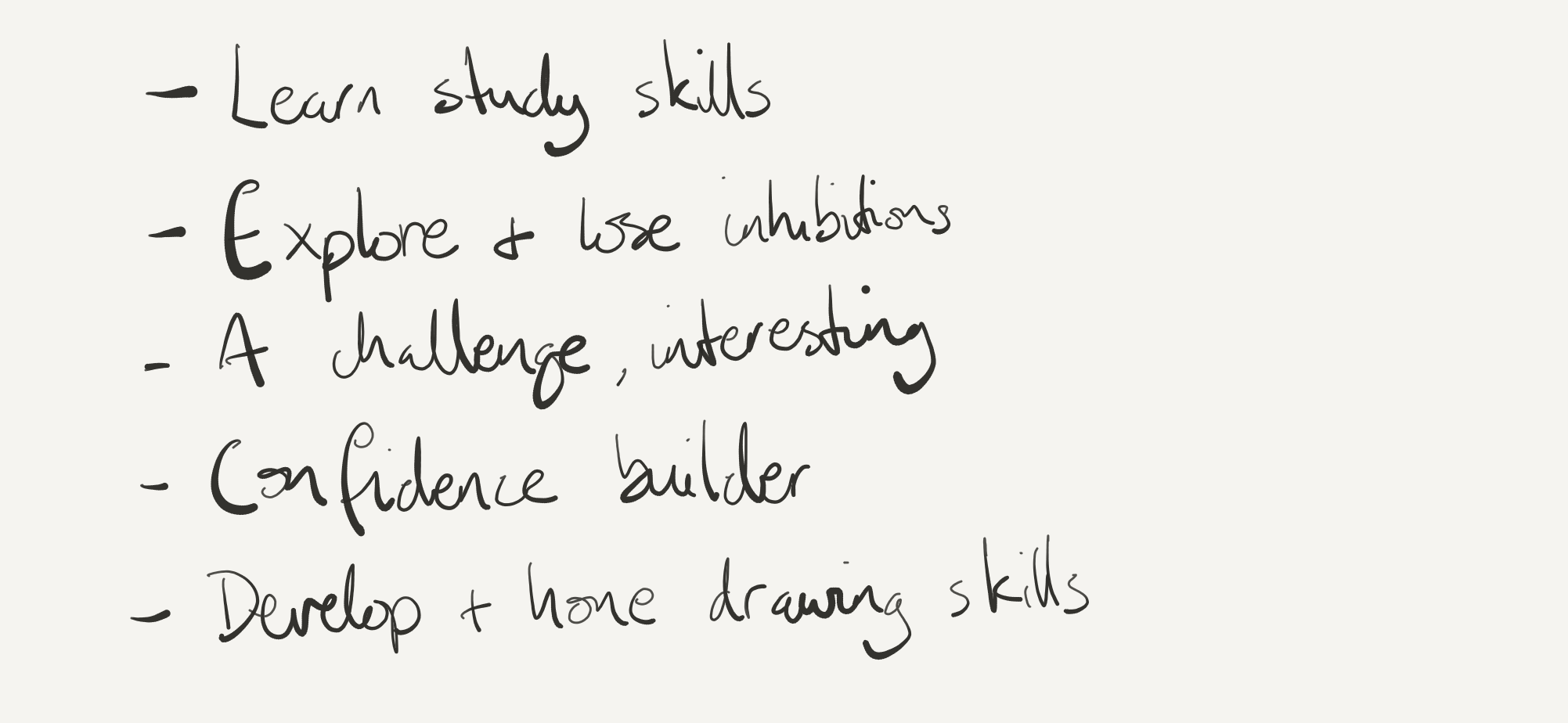
Essentially, these are my goals!

Choosing the Drawing For Textile Art, Design and Fashion course seemed like a great first step along the path I want to go down with my studies. I hope it will ease me into Higher Education in a way that is enjoyable and interesting, and a challenge without being too large a task to complete. It will teach me how to study at this level and let me learn all the skills I need before embarking on a degree.

Having studied on various art courses before, I anticipate this should be a slight sidestep from what I already know, something that can build upon skills I already have, but let me develop them in a new way. I expect it will keep me on my toes a bit, but also keep me engaged because the subject matter is new, and therefore nothing should be boring. I know I already have some drawing skill, and capability for drawing what’s in front of me, and even drawing from my imagination; a large part of what I hope to achieve with this course is seeing what’s in front of me and how to draw those things in new ways, and to find different ways to use and develop what I draw. And also to lose any inhibitions I have of what constitutes a “good” drawing, learning to mark make and explore the page for the sake of it, not just for some planned outcome.

I hope if there’s anything that is a repeat of previous skills I’ve learned I should get through those sections quickly, and be able to power through to new sections, and progress more quickly through the assignments.

Because of problems with my health – which I will attempt not to go into too much here on the blog, to keep this about art and work, not personal – I do work slowly sometimes and in a broken up manner, and I do have some concerns about that. That it will make it difficult to gain any momentum and I’ll end up stuck in a slog of feeling like I am not moving forward, especially if i also find the work harder than anticipated. This is why it will be good to remember the reasons why I started in the first place, and I need to remember that I work the way I do to best protect my health, and make sure I’m rested enough not to burn out or cause a relapse. This Foundation Course should, I hope, help me learn how to work at the level required within the confines of my illness and pain management, to give me the confidence that I can do what’s needed once I find a way that works for me.

It’s my first step back into a more organised and well run education system since I was a teenager, which is an exciting prospect. I want this to be fun and informative if nothing else, and the course sounded like something I can sink my teeth into. I look forward to getting going!

An Introduction

Hello, and here you’ve found yourself on my learning log for my Open College of the Arts studies. I will use this blog as a means to document my learning process, reflect on the subject at hand, and show progress and updates on where I am with my studies.

There will be blog entries periodically throughout the course for my tutor to look at and help assess my ability and progress, and hopefully some fun and optional posts in between where I can show what I’m up to that week and what’s on my mind. Everything should be documented in the correct menus for course work and more personal posts dropped hither and thither as they come. (Once I figure out the specifics of course, I’m sure it can’t be that hard, right?)

I hope that keeping my learning log in blog format, and those who I share it with and follow along with me, will keep me motivated and interested, and make sure I keep on top of everything I should. Watch this space, there’ll be more to come!

Design a site like this with WordPress.com
Get started